
There’s a moment most founders know well.
You’ve hired a development agency — offshore, affordable, with a portfolio that looked solid. Three months in, you’re on a call at 11pm trying to explain, for the fourth time, why the feature works the way it works. The code ships. It mostly works. But something is always slightly off, and you can never quite put your finger on what.
This isn’t a story about bad developers. It’s a story about the hidden costs of the wrong kind of outsourcing.
The real cost of offshore development isn’t the hourly rate
When founders calculate the cost of working with an offshore team in India, Pakistan, or even parts of Southeast Asia, they look at one number: the hourly rate. $25/hour versus $85/hour looks like an obvious win.
What that calculation misses:
Timezone friction. An 8-hour gap means your feedback sits overnight. A two-week sprint becomes a three-week sprint. Multiply that across a year and you’ve lost months of velocity — not because anyone was lazy, but because the window for real-time collaboration is a single awkward hour in the morning.
Communication overhead. Every ambiguity in a spec costs more when clarification takes 24 hours. Senior developers in your timezone can ask questions and get answers in minutes. The same question offshore adds a day.
Context loss. Good software requires understanding your business, not just your tickets. That understanding builds in conversation — calls, quick Slack messages, whiteboard sessions. It doesn’t build across a 9-hour timezone gap and a language barrier.
By the time you account for project management overhead, rework, slower iteration, and your own time spent on calls you shouldn’t need to have — the effective rate of offshore development is rarely what it appears on paper.
Why Ukraine became the go-to answer — and why that’s changed
For a decade, Eastern Europe — particularly Ukraine — was the default answer for founders who wanted quality development without San Francisco prices. And it worked well. The talent was strong, the timezone was manageable for European companies, and the cultural fit with Western business practices was solid.
Then February 2022 happened.
The talent is still there. The quality is still there. But the reliability isn’t — and for a founder building something that needs to ship consistently, reliability is the entire game. Working with a team that might lose power, connectivity, or team members at any moment is a risk that’s hard to price into a project.
This created a gap. And Croatia, along with a handful of other EU countries, stepped into it.
What Croatia actually offers
Croatia joined the EU in 2013. That single fact changes the calculus for a lot of founders in ways that aren’t immediately obvious.
GDPR compliance is default, not an add-on. If you’re building anything that handles European user data — which is most products — working with an EU-based team means your development partner operates under the same regulatory framework you do. No data transfer agreements, no legal grey areas, no explaining to your lawyer why your code is being written in a jurisdiction with different privacy standards.
Contracts that hold. EU contract law is enforceable in ways that offshore contracts often aren’t in practice. If something goes wrong — and sometimes things go wrong — you have recourse.
Timezone overlap with the UK and Western Europe. Croatia is UTC+1/UTC+2. London is UTC+0/UTC+1. That’s a one-hour difference at most. A full working day of overlap. Real-time collaboration, same-day feedback, no 11pm calls.
English fluency. Croatia consistently ranks among the top countries in Europe for English proficiency. Not just technically proficient English — conversational, business-level English that makes standup calls and product discussions feel natural rather than labored.
Strong technical education. Croatian universities — particularly the Faculty of Electrical Engineering and Computing in Zagreb — produce engineers with deep computer science fundamentals. This isn’t a bootcamp talent pool. It’s a country with a 30-year history of technical education producing developers who understand systems, not just frameworks.
The “nearshore” advantage nobody talks about enough
There’s a term for what Croatia offers: nearshore. Same continent, close timezone, cultural alignment, lower cost than Western Europe or the US.
But the advantage that doesn’t get talked about enough is what proximity does to the relationship over time.
When your development partner is in Croatia and you’re in London or Amsterdam, you can fly there in two hours. You can have a quarterly planning session in person. You can bring them to your office for a sprint kickoff. You can have dinner together.
That sounds like a small thing. It isn’t. The best client-agency relationships are built on trust, and trust is built in rooms — not just on calls. Nearshore makes that possible in a way that offshore never will.
What to look for in a Croatian development partner
Not all Croatian dev shops are the same. Here’s what actually matters:
They build their own products. A team that ships their own software thinks differently than a team that only executes client tickets. They’ve felt the pain of bad architecture decisions, late-night production bugs, and the difference between code that works in a demo and code that works at scale. That experience transfers directly to your project.
They have a real portfolio with real clients. Screenshots are easy. Ask for case studies with actual problem statements, actual constraints, and actual outcomes. If they can’t articulate what problem they solved and why they solved it the way they did, that’s a signal.
They push back. The best development partners don’t just execute. They ask why. They suggest alternatives. They tell you when your spec has a problem before they build it. If a team never pushes back on anything, they’re order-takers — not partners.
They’re honest about what they can’t do. A team that claims expertise in everything has expertise in nothing. Look for specificity: what verticals do they know well, what stack are they genuinely senior in, where do they draw the line.
The honest answer about cost
Croatian development rates typically sit between €50-120/hour depending on seniority and specialization. That’s more than India, less than London or Berlin.
But for most founders building serious products, the question isn’t “how do I minimize my hourly rate?” It’s “how do I maximize the amount of working, shippable, maintainable software I get per euro spent?”
When you factor in timezone efficiency, communication quality, lower rework rates, and the ability to actually build a relationship with your team — the effective cost per feature of a good Croatian team often beats offshore alternatives that look cheaper on paper.
Why we’re writing this
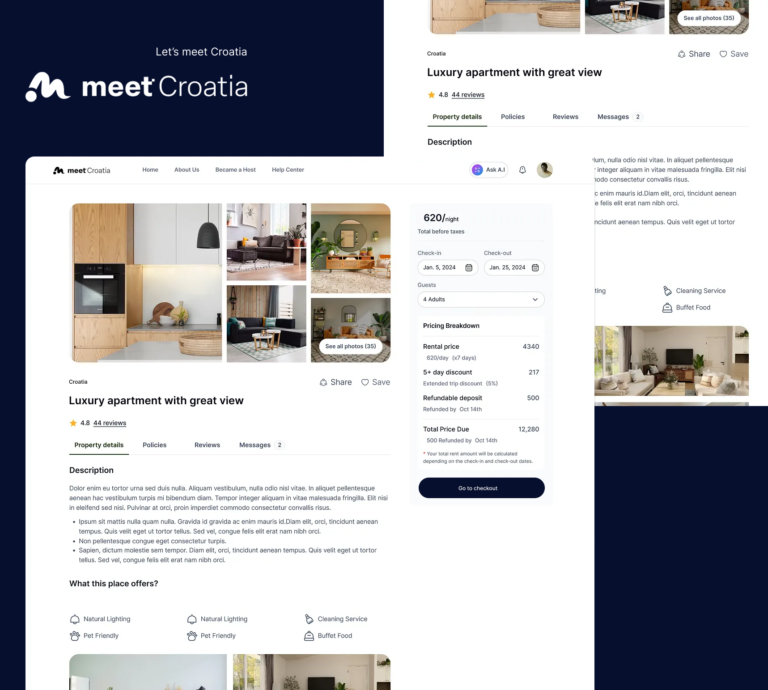
We’re Immense — a software company based in Croatia. We build our own platforms (a tourism marketplace, an all-in-one business system for the Croatian market) and we work with a small number of external clients across Europe and the UK as a development partner.
We’re writing this because we’ve had versions of this conversation dozens of times with founders who came to us after a frustrating experience with offshore teams. We’re not claiming to be the only good option. We’re claiming that Croatia, and the nearshore model, deserves more serious consideration than it typically gets from founders who default to the cheapest option and pay for it later.
If you’re evaluating development partners and want to talk through what your project actually needs — not a sales call, just a honest conversation — you know where to find us.
Immense is a software development company based in Zagreb, Croatia. We specialize in Node.js, Next.js, React, AWS, and PostgreSQL — and we’ve shipped broadcast infrastructure, travel marketplaces, ERP systems, and custom platforms for clients across Croatia and Europe.